Every year the Health and Safety Executive (HSE) publishes its Health and safety at work statistics — the most authoritative picture we have of how people are hurt and made ill by their jobs in Great Britain. As we move through 2026, the most recent official data available (covering 2024/25) confirms what every employer should take seriously: workplace harm is still widespread, still costly, and in most cases still preventable.
This guide pulls together the headline figures, breaks down where and how people are injured and made ill, sets out what it all costs — and explains what it means for first aid provision in your workplace. Every number here is drawn from official HSE data and fully referenced, so it's a resource you can cite. We'll refresh the page as the HSE releases newer figures.
The headline figures
The HSE's key figures for Great Britain set out the scale of the problem in a single year:
In other words, in a typical year:
- 124 workers were killed in work-related accidents, and a further 92 members of the public died in work-related incidents.
- 680,000 working people sustained a non-fatal injury at work (self-reported, Labour Force Survey).
- 1.9 million workers were suffering from an illness they believe was caused or made worse by work.
- 40.1 million working days were lost to work-related ill health and non-fatal injury.
- Workplace injury and new cases of ill health cost Britain an estimated £22.9 billion a year.
Fatal injuries at work
124 workers were killed in work-related accidents in 2024/25 (a provisional figure, finalised by the HSE in July 2026). The long-term trend in fatal injuries has fallen substantially over the last few decades, but in recent years it has broadly levelled off.
The single most common cause of death was a fall from a height, which killed 35 workers — more than a quarter of the total. Being struck by a moving vehicle or object, and being trapped by something collapsing or overturning, also account for a large share of deaths each year.
Fatalities are concentrated in a few higher-risk sectors. Construction records the largest number of worker deaths in absolute terms, while agriculture, forestry and fishing has one of the highest fatal-injury rates relative to the number of people it employs. Work-related death isn't limited to employees, either: 92 members of the public were killed in work-related incidents in 2024/25.
Non-fatal injuries: how common, and what kind
An estimated 680,000 working people sustained a non-fatal injury at work in 2024/25 (self-reported, Labour Force Survey). Employers reported non-fatal injuries to employees under RIDDOR at a rate of 209 per 100,000 employees — a figure that has followed a long-term downward trend.
A handful of accident types account for most workplace injuries:
| Kind of accident | Share of injuries |
|---|---|
| Slips, trips or falls on the same level | 30% |
| Handling, lifting or carrying | 17% |
| Struck by a moving object | 10% |
| Acts of violence | 10% |
| Falls from a height | 8% |
Falls from a height make up only around 8% of non-fatal injuries but, as we've seen, are the leading cause of fatal injury — a reminder that the most frequent accidents and the most dangerous ones aren't always the same. For a workplace first aider, the day-to-day reality is fractures, sprains, head injuries, cuts and the after-effects of a fall — exactly the scenarios covered in an Emergency First Aid at Work course.
Slips, trips and falls are the single most common cause of workplace injury — and among the most preventable.
Work-related ill health
Injuries are only part of the story. An estimated 1.9 million workers were suffering from work-related ill health in 2024/25, and on average 679,000 workers a year report a new case. Rates of self-reported ill health remain higher than the pre-pandemic levels recorded in 2018/19.
| Type of ill health | Workers affected | Share | Working days lost |
|---|---|---|---|
| Stress, depression or anxiety | 964,000 | 52% | 22.1 million |
| Musculoskeletal disorders | 511,000 | 27% | 7.1 million |
| Other illness | — | 21% | — |
| All work-related ill health | 1.9 million | 100% | — |
Stress, depression or anxiety is now the single biggest cause of work-related ill health, affecting 964,000 workers — about 52% of all cases. It is most often driven by high workloads, tight deadlines and a lack of support from managers, and each affected worker took an average of around 16.4 days off. Musculoskeletal disorders — back, neck and limb problems — affected a further 511,000 workers.
That's why a growing number of employers now train designated mental health first aiders alongside their physical first aid cover, giving someone the skills to spot the signs early and point colleagues towards the right support.
Working days lost
Work-related ill health and injury cost Britain an estimated 40.1 million working days in 2024/25. Ill health accounts for the overwhelming majority of that lost time: 22.1 million days were lost to stress, depression or anxiety and 7.1 million to musculoskeletal disorders.
For an employer, that lost time translates directly into disrupted projects, overtime and cover costs, and pressure on the colleagues who pick up the slack — which is why prevention and a quick, confident response to incidents matter to the bottom line as well as to staff welfare.
The cost to Britain
The HSE estimates the total cost of workplace injury and new cases of ill health at £22.9 billion (2023/24). Work-related ill health makes up by far the largest share:
| Category | Cost | Share |
|---|---|---|
| Work-related ill health | £16.4 billion | 72% |
| Workplace injury | £6.5 billion | 28% |
| Total | £22.9 billion | 100% |
Most of that cost is borne by individuals (around £13.4 billion), followed by government (£5.2 billion), with employers bearing roughly £4.3 billion directly. But for a single business, one serious incident can mean an HSE investigation, a fine, higher insurance premiums, lost productivity and lasting damage to staff trust — costs that don't show up in the national totals.
Why the true numbers are higher
One important caveat sits behind all of this: under-reporting. The HSE estimates that employers report only around half of the non-fatal injuries to employees that they are legally required to report under RIDDOR. The official injury counts are therefore conservative — the real frequency of workplace injury is higher than the reported figures suggest.
That's a useful reality check if your own workplace has a quiet accident book. Few or no recorded incidents doesn't necessarily mean low risk; it can simply mean incidents aren't being captured.
What this means for your workplace
The statistics make a clear case: injuries and medical emergencies at work are common, and the minutes immediately after one happens are often decisive. Effective first aid in those first few minutes — controlling severe bleeding, opening an airway, starting CPR, using a defibrillator — is frequently the difference between a near miss and a tragedy.
Trained first aiders also make an organisation calmer and more capable day to day. They know how to assess a casualty, when to call 999, and how to keep a situation under control until the ambulance arrives — and that confidence spreads across a team.
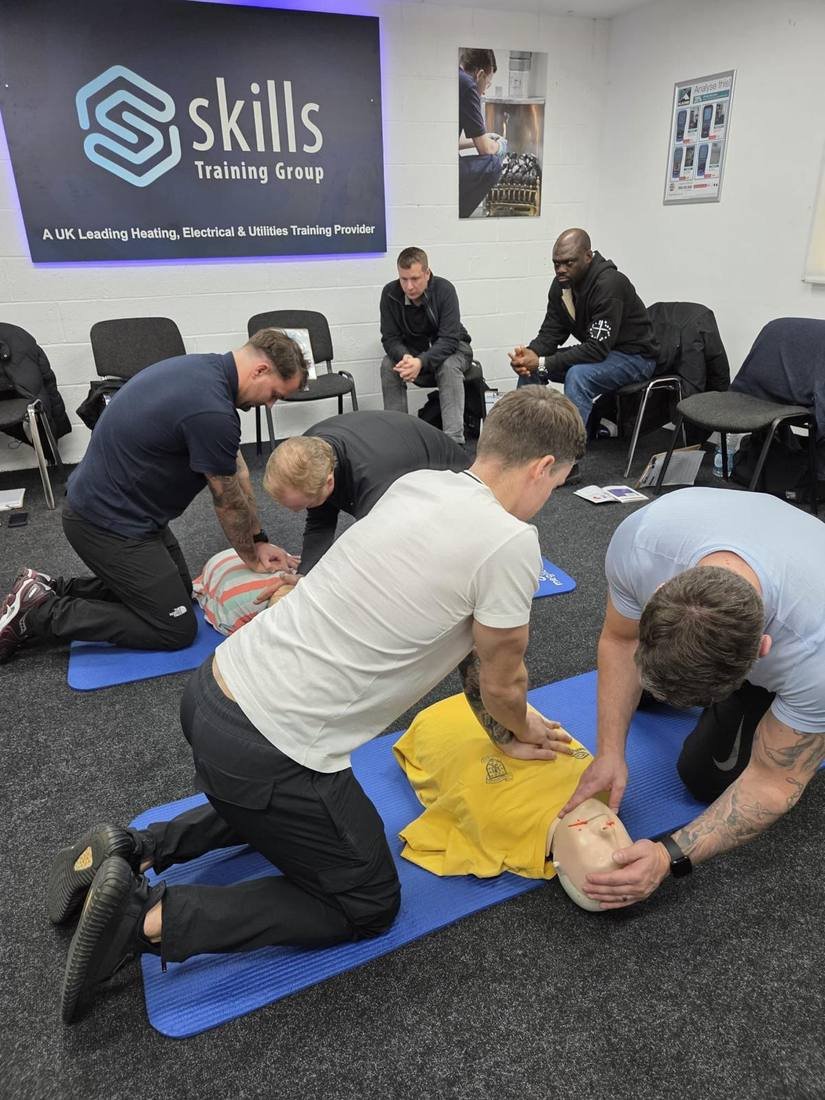
That's the case for proper training. Onsite First Aid Training delivers accredited first aid courses on site at your workplace, anywhere in the UK — practical, hands-on sessions built around the real emergencies these statistics describe.
Your first aid duties under the law
Under the Health and Safety (First-Aid) Regulations 1981, every employer must provide "adequate and appropriate" first aid equipment, facilities and people, so that staff who are injured or taken ill at work can be given immediate help. What counts as "adequate" depends on a first aid needs assessment that considers your workplace's hazards, size and history.
In practice that usually means:
- A suitably stocked first aid kit and an appointed person to take charge of arrangements, as a minimum.
- One or more trained first aiders for most workplaces — holding either Emergency First Aid at Work (EFAW) for lower-risk environments, or the full First Aid at Work (FAW) qualification for higher-risk ones.
- Keeping skills current — the HSE strongly recommends an annual refresher between the three-yearly requalifications.
Not sure how many first aiders your workplace needs, or which course is right? Get in touch and we'll help you carry out a needs assessment and build the right cover.
Frequently asked questions
How many people are injured at work in the UK each year?
Around 680,000 working people sustained a non-fatal injury at work in 2024/25, according to the HSE's Labour Force Survey. Employers reported injuries to employees under RIDDOR at a rate of 209 per 100,000, and the HSE estimates only around half of reportable injuries are actually reported — so the true figure is higher.
How many workers die at work in the UK?
124 workers were killed in work-related accidents in 2024/25 (a provisional HSE figure). A further 92 members of the public were killed in work-related incidents. The most common cause of worker deaths was falls from a height.
What is the most common cause of workplace injury?
Slips, trips and falls on the same level. They account for around 30% of non-fatal injuries to employees reported under RIDDOR, making them the single biggest category, followed by handling, lifting or carrying at 17%.
What is the most common cause of work-related ill health?
Stress, depression or anxiety. An estimated 964,000 workers were affected in 2024/25 — about 52% of all work-related ill health cases. Musculoskeletal disorders are the next most common, affecting 511,000 workers.
How much do workplace injuries and ill health cost?
An estimated £22.9 billion a year (2023/24). Work-related ill health accounts for about 72% of that (£16.4 billion) and workplace injury about 28% (£6.5 billion).
How many working days are lost to work-related ill health and injury?
An estimated 40.1 million working days were lost in 2024/25 — 22.1 million to stress, depression or anxiety and 7.1 million to musculoskeletal disorders.
How many working days are lost to stress at work?
Stress, depression or anxiety accounted for 22.1 million working days lost in 2024/25 — more than half of all working days lost to work-related ill health and injury. On average, each affected worker took around 16.4 days off.
What percentage of workplace injuries are slips, trips and falls?
Slips, trips and falls on the same level account for around 30% of non-fatal injuries to employees reported under RIDDOR — the single largest category of workplace injury in Great Britain.
How many people die from falls at work in the UK?
Falls from a height killed 35 workers in 2024/25, making it the most common cause of work-related death — more than a quarter of the 124 worker fatalities recorded that year.
Sources
All figures are drawn from the Health and Safety Executive (HSE), the UK's national regulator for workplace health and safety. Headline data is for Great Britain, 2024/25; the cost estimate is for 2023/24:
- HSE — Key figures for Great Britain (2024/25)
- HSE — Work-related fatal injuries in Great Britain
- HSE — Non-fatal injuries at work in Great Britain
- HSE — Work-related ill health and occupational disease
- HSE — Working days lost in Great Britain
- HSE — Costs to Great Britain of workplace injuries and ill health
Figures reflect the HSE's published data at the time of writing (June 2026); the 2024/25 fatal-injury figures are provisional and are finalised by the HSE in July 2026. We update this page as newer data is released.
Get your team first aid ready
We deliver accredited first aid training on site at your workplace, anywhere in the UK — from the one-day Emergency First Aid at Work course to the full 3-day First Aid at Work qualification. Not sure what you need? We'll help you work it out.

About the author
Mark McShane is the founder of Skills Training Group, the parent company of Onsite First Aid Training, which delivers accredited first aid, fire safety and compliance training to organisations across the UK.